The hidden cost of manual payroll infrastructure
Before switching to automated rails, most DAOs treated payroll like a part-time administrative task rather than a core operational system. The result was a patchwork of spreadsheets, manual bank transfers, and scattered stablecoin payments that created significant compliance risk. One major DAO managing contributors across 20+ countries found that manual processing consumed over 15 hours of administrative time per month, with a 4% error rate in payment routing (source: Transfi Case Study).
The primary constraint was not the technology, but the lack of standardized infrastructure for cross-border compliance. Without automated rails, DAOs had to manually verify contributor identities, track jurisdictional tax rules, and reconcile payments across multiple chains. This manual overhead made scaling difficult and exposed the organization to regulatory scrutiny.
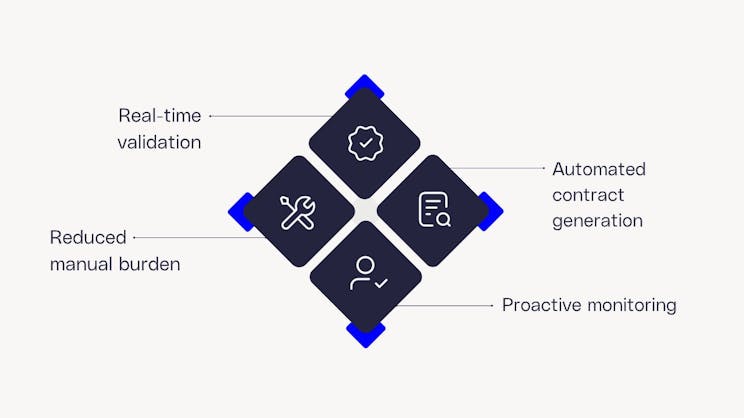
Automating payroll infrastructure shifts the burden from administrative labor to code-based compliance. Systems like Utopia allow DAO managers to set recurring payments and automate expense management, reducing the manual touchpoints that lead to errors (source: Vircon Legal). This shift enables DAOs to focus on governance and development rather than payment logistics.
Dao payroll infrastructure choices that change the plan
Choosing a payroll rail means balancing speed, compliance, and cost. No single platform fits every DAO treasury. The right infrastructure depends on your team's location, token holdings, and legal structure.
Stablecoin vs. Fiat Rails
Stablecoin payroll handles cross-border transfers instantly. Fiat rails require banking partners and take days to settle. Stablecoins reduce FX risk but expose contributors to volatility if not managed. Fiat offers familiar tax reporting but adds friction for remote teams.
On-Chain vs. Off-Chain Automation
On-chain payroll executes directly from the treasury. It offers transparency but requires smart contract audits. Off-chain tools like Vircon Legal or Rise connect to wallets. They offer easier UX but introduce a trusted third party. Choose on-chain for maximum sovereignty; off-chain for simplicity.
Compliance and Tax Reporting
Global compliance is the hardest part. Some platforms integrate with tax APIs. Others leave reporting to the contributor. If your team spans 20+ countries, automated compliance tools reduce legal overhead. Manual tracking increases liability.
Cost and Fees
Transaction fees vary by blockchain. Solana offers low-cost streaming payments. Ethereum mainnet can be expensive for small payouts. Consider gas costs, platform fees, and banking charges. Low-volume DAOs may prefer fiat to avoid network congestion.
| Factor | Stablecoin Rails | Fiat Rails | Hybrid |
|---|---|---|---|
| Speed | Instant | 1-3 days | Mixed |
| Cost | Low gas | High fees | Moderate |
| Compliance | Manual/Auto | Automated | Automated |
| Risk | Volatility | Banking | Low |
The best DAO payroll system combines the speed of crypto with the safety of fiat rails. Evaluate each factor based on your team's specific needs.
Choose the next step
Automating Global Compliance works best as a clear sequence: define the constraint, compare the realistic options, test the tradeoff, and choose the path with the fewest hidden costs. That order keeps the advice usable instead of decorative. After each step, pause long enough to check whether the recommendation still fits the reader's actual situation. If it depends on perfect timing, unusual access, or a best-case budget, include a simpler fallback.
Spotting Weak Crypto Payroll Claims
Many vendors promise "fully automated global compliance" for DAOs, but the reality is often fragmented. When evaluating payroll rails, focus on where the automation actually stops and human intervention begins.
The "One-Click" Compliance Myth
Vendors often claim their platform handles all local tax withholdings. In practice, most systems only execute the stablecoin transfer. The DAO still must reconcile these payments against local labor laws in each of the 20+ countries involved. If the platform doesn't explicitly list supported jurisdictions with current tax codes, it is just a payment processor, not a compliance solution.
Hidden FX Friction
Some tools advertise zero-fee payouts. However, they may embed foreign exchange spreads into the conversion rate. For cross-border payroll, a 1-2% spread on large monthly budgets quickly erodes the savings from reduced administrative overhead. Always request a full breakdown of fees, including network gas costs and currency conversion margins.
Data Silos and Audit Trails
Weak options often isolate payroll data from governance voting records. A robust rail integrates with your DAO's treasury management and snapshot voting systems. Without this integration, you lose the ability to prove that payroll approvals were authorized by token holders, creating a compliance gap during external audits.
Dao payroll infrastructure: what to check next
Before committing to a new payroll rail, teams need to verify how these systems handle real-world friction points like tax compliance and liquidity. The following answers address the most common operational concerns for DAOs moving to stablecoin payroll in 2026.
Understanding these mechanics helps teams choose the right rail. Whether you need streaming payouts for developers or fixed monthly salaries for administrators, the infrastructure is now mature enough to handle global distribution efficiently.
No comments yet. Be the first to share your thoughts!