
Confidential Payroll for DAOs: Zero-Knowledge Proofs for Web3 Team Privacy

0
Confidential Payroll for DAOs: Zero-Knowledge Proofs for Web3 Team Privacy

Decentralized Autonomous Organizations (DAOs) thrive on transparency, but payroll processes expose a glaring vulnerability: public blockchains reveal contributor wallets, salaries, and payout schedules to anyone with a block explorer. In a world of DAO confidential payroll, zero-knowledge proofs (ZKPs) emerge as the technical solution to shield web3 team payroll privacy without sacrificing verifiability. Protocols now enable DAOs to settle payments onchain while keeping sensitive details off-ledger, addressing the tension between openness and individual privacy.


Abstract illustration of a shielded vault using zero-knowledge proofs for secure, private DAO payroll payments in Web3

This shift matters for global teams managing multi-currency payouts. Traditional payroll rails struggle with forex volatility and tax reporting, but ZKP-integrated systems add privacy layers atop automated conversions. Recent deployments, like those on Starknet, demonstrate how DAOs can process private on-chain payroll web3 style, ensuring contributors remain pseudonymous even as treasuries execute precise, compliant distributions.

ZKPs Under the Hood: Proving Payroll Without Exposure

Zero-knowledge proofs allow one party to prove a statement’s truth to another without revealing underlying data. In zero-knowledge payroll DAOs, this means verifying a contributor earned a salary, met vesting conditions, and qualifies for payout, all without disclosing the exact amount or wallet address. Mathematically, ZKPs rely on protocols like zk-SNARKs or zk-STARKs, where a prover generates a compact proof attesting to a computation’s correctness.

For payroll, consider a contributor submits a proof that their work hours multiplied by hourly rate equals claimed pay, constrained by DAO governance rules. The smart contract checks the proof in constant time, settling funds to a blinded address. Tools like Circom or Noir compile these circuits, optimizing for gas efficiency on L2s like Starknet. This selective disclosure prevents doxxing risks, common in transparent chains where salary leaks fuel social engineering attacks.

Integration with confidential computing amplifies this. Nillion’s nilCC and nilDB, for instance, use Secure Multi-Party Computation (SMPC) to process encrypted data across nodes, blending ZKPs with blind computation. No single node sees plaintext salaries, yet the network outputs valid proofs for onchain settlement.

Civitas and Nillion: Pioneering Private Payroll Infrastructure

Meet Civitas exemplifies ZK proofs DAO payments in action. Deployed on Starknet, it leverages Nillion’s privacy stack for zero-knowledge payroll settlement tailored to DAOs and web3 teams. Tweets from projects highlight the breakthrough: private payroll is now fully onchain, securing financial privacy end-to-end.

Running a Web3 org means your entire payroll is a public billboard.

Competitors see your runway. Employees see each other’s salaries. It’s an existential threat to mainstream adoption.

So, @Swarnasn29 and I built the cure.

Introducing @meet_civitas

We built a zero-knowledge

Today, when a DAO pays a contributor, the wallet, amount, and timestamp are permanently public.

Anyone can map your compensation structure from the treasury.

Civitas separates payroll transparency from employee privacy.

Employers commit payroll obligations onchain using cryptographic commitments.

Contributors claim their earnings using zero-knowledge proofs, without revealing identity or linking their wallet to their compensation.

Once a payroll cycle is committed, the employer cannot alter the amounts or block withdrawals.

Workers can independently claim what they are owed, and the contract enforces every obligation automatically.

The system removes discretion while preserving confidentiality.

Civitas integrates Nillion’s nilDB for confidential storage and nilCC for secure enclave-based compute.

Sensitive payroll data stays encrypted and privately processed instead of being exposed to public infrastructure.

Civitas is opening its MVP for a closed pilot.

If you’re a DAO or Web3 team ready to implement confidential payroll, they’re looking for 3–5 early beta partners.

Reach out to @meet_civitas to get involved.

@thatmarkmac @meet_civitas Gnillion

@privymaxi @meet_civitas ⚔️

@meet_civitas Privacy is normal and Nillion is the way

Nillion itself operates as a non-blockchain network of nodes performing operations on encrypted data via SMPC. Unlike traditional chains, it avoids blocks, focusing on decentralized compute for web3. This pairs seamlessly with Starknet’s STARK proofs, enabling scalable, private payroll rails. For DAOs, the result is total control: prove compliance with tax rules, vesting schedules, and contribution metrics without exposing treasuries or individual earnings.

Other players reinforce the trend. Partnerships like Aleo, Toku, and Paxos Labs deliver compliant global crypto payroll using ZK tech, solving privacy gaps for businesses. Aragon notes ZKPs’ role in private organizations, allowing secret inputs on public systems. Updated contexts show zkMe issuing confidential credentials, while TEEs in decentralized AI platforms process sensitive payroll data securely.

Navigating Regulations and Forex in Private Payroll

Global teams demand more than privacy; they need confidential DAO payroll that handles cross-border compliance. ZKPs prove tax withholdings and residency status without revealing identities, integrating with tools for instant currency conversion. In volatile forex markets, DAOs forecast rates technically, then settle in stablecoins or fiat ramps privately.

Consider a contributor in Brazil paid in USDC: the DAO verifies eligibility via ZKP, converts at real-time rates, and withholds local taxes blindly. Protocols like Civitas automate this, reducing audit burdens while scaling for hundreds of members. Challenges persist, like proof generation costs, but L2 optimizations and hardware acceleration via projects like Galot’s ZK cloud mitigate them.

L2 optimizations slash these costs dramatically; Starknet’s native STARKs process proofs at fractions of Ethereum gas prices, making zero-knowledge payroll DAOs viable for small treasuries. Hardware operators in networks like Galot’s ZK cloud distribute proof generation, further democratizing access for web3 teams.

Build ZKP Confidential Payroll for DAOs: Circom to Stealth Disbursements
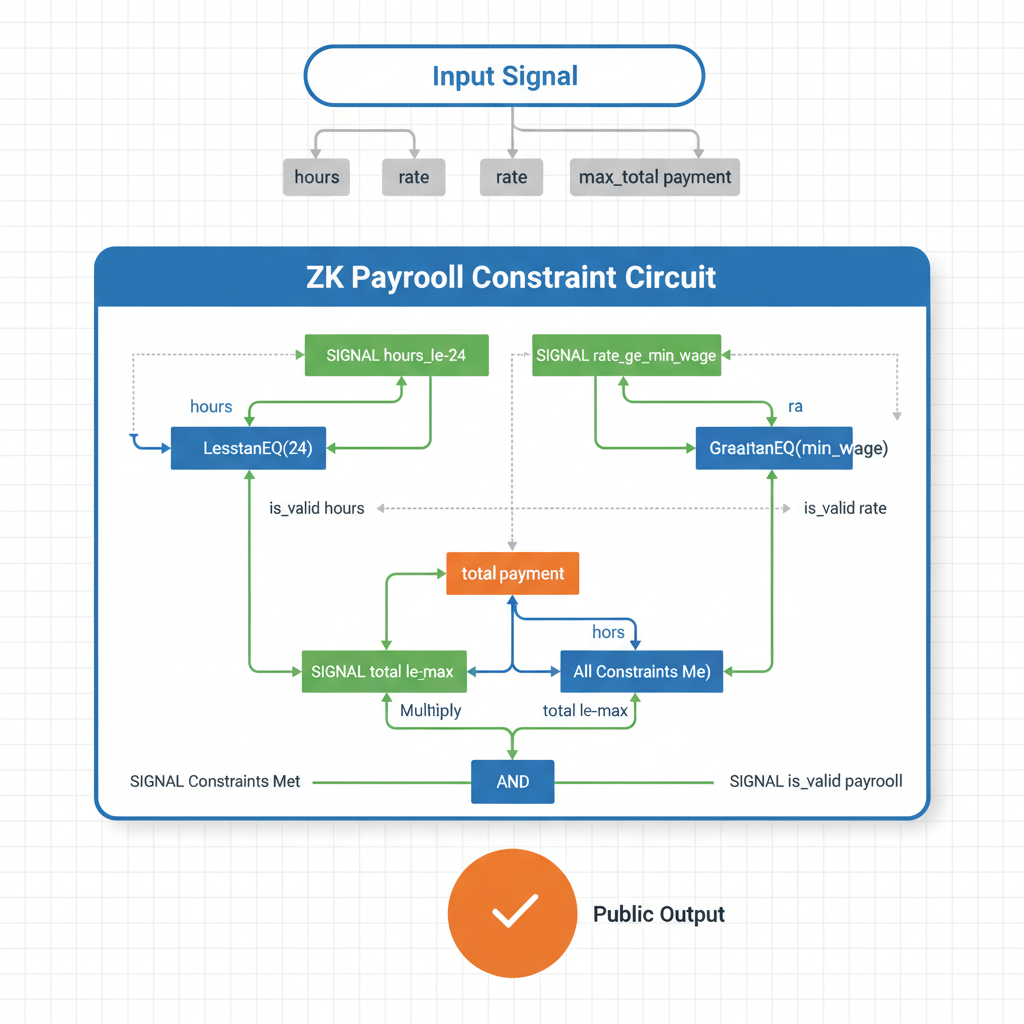
detailed circom circuit diagram for zk payroll hours rate constraints
Design Payroll Circom Circuit
Define Circom circuit for payroll logic: inputs include private hours worked (uint32, 0-168/week), hourly rate (uint256), constraints (max hours, VAT rate 20%). Output: total salary masked for privacy. Use template for multiplication/addition with range proofs. Example: signal input hours; signal input rate; signal output salary = hours * rate * (1 + vat); enforce hours <= 40.
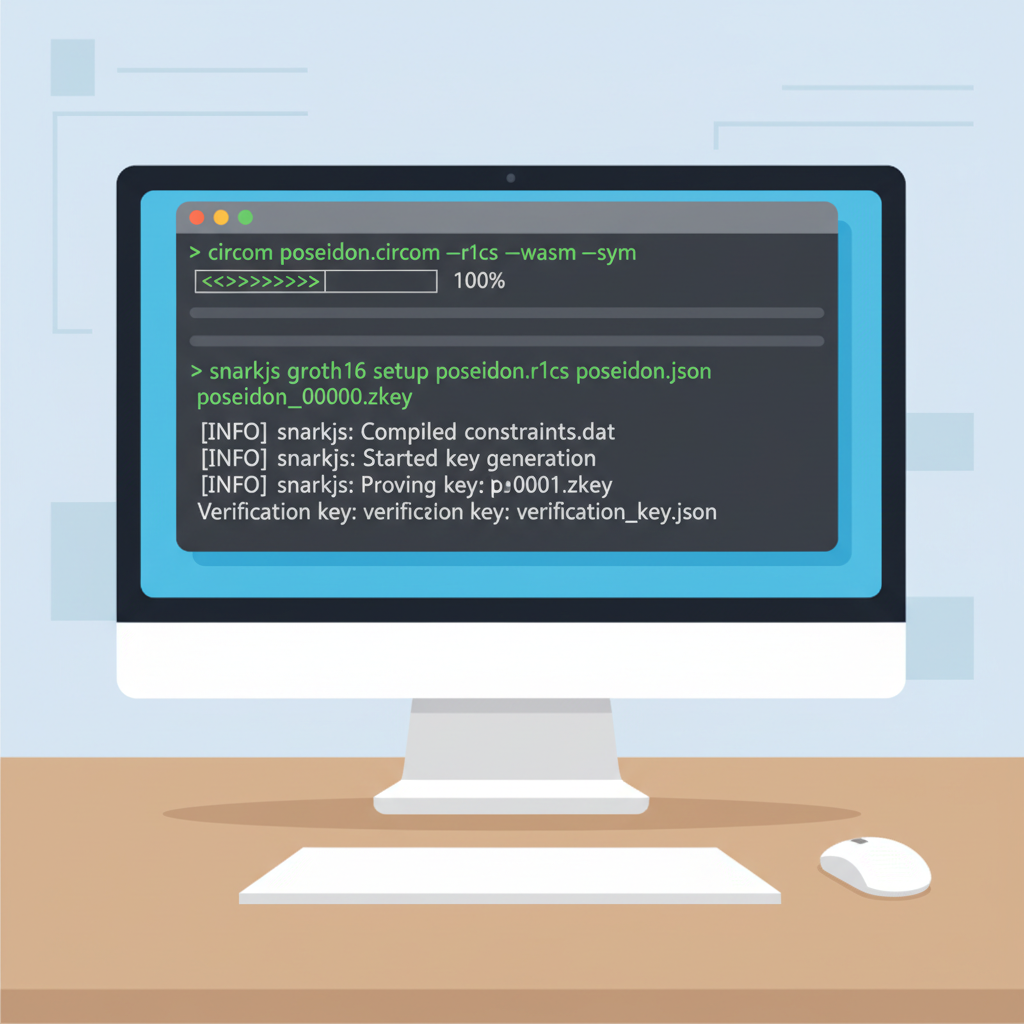
terminal window compiling circom circuit snarkjs keys
Compile Circuit & Generate Keys
Install Circom and snarkjs: npm i circomlib snarkjs. Compile: circom payroll.circom –r1cs –wasm –sym. Run trusted setup: snarkjs groth16 setup payroll.r1cs powersOfTau28_hez_final_10.ptau payroll_0000.zkey; snarkjs zkey contribute … final.zkey. Export verifier: snarkjs zkey export verifier verifier.sol.
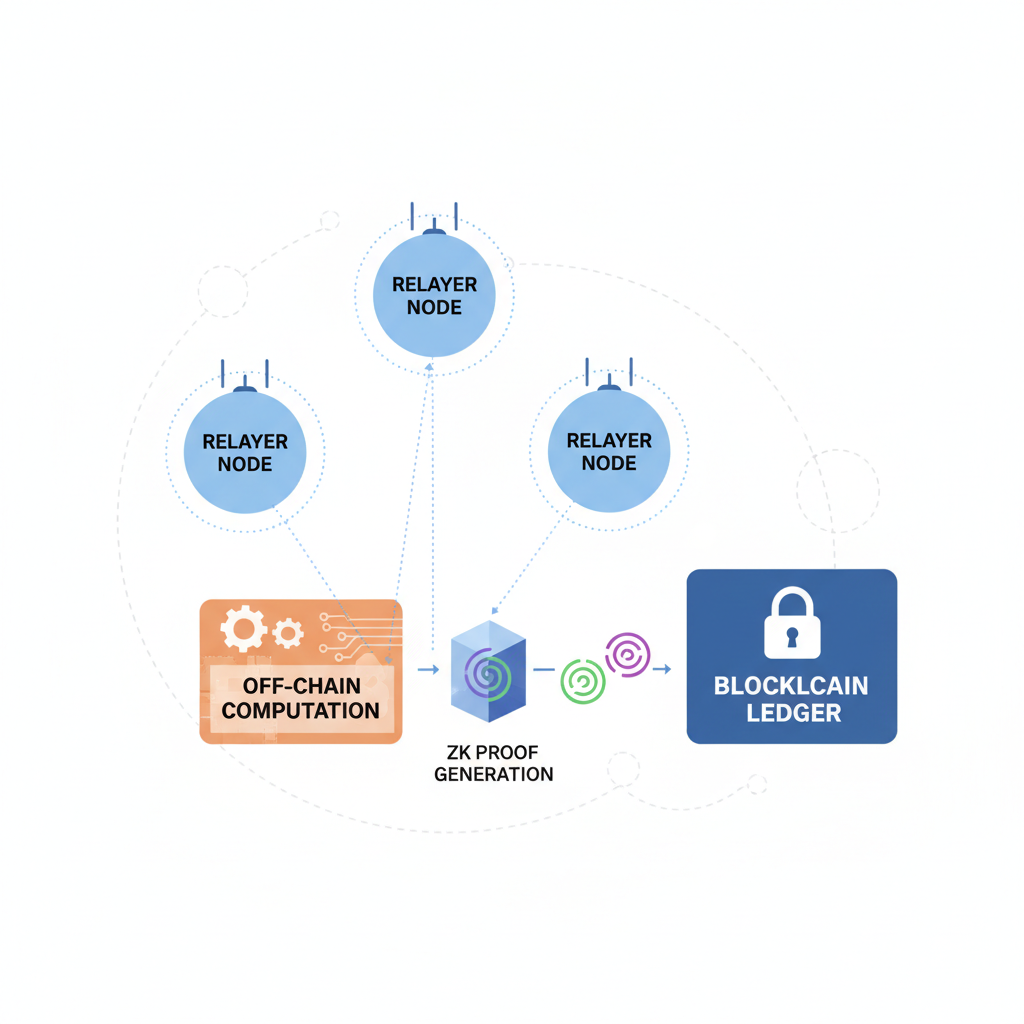
decentralized relayer nodes generating zk proof offchain
Offchain Proof Generation via Relayers
Use relayer nodes (inspired by Nillion’s nilCC/nilDB or Starknet setups like meet_civitas) for proof computation. Client submits encrypted inputs (hours, rate); relayer computes witness/proof without decryption via MPC or TEEs. Output: proof + public signals (salary commitment). Integrate with Noir or Halo2 for efficiency.
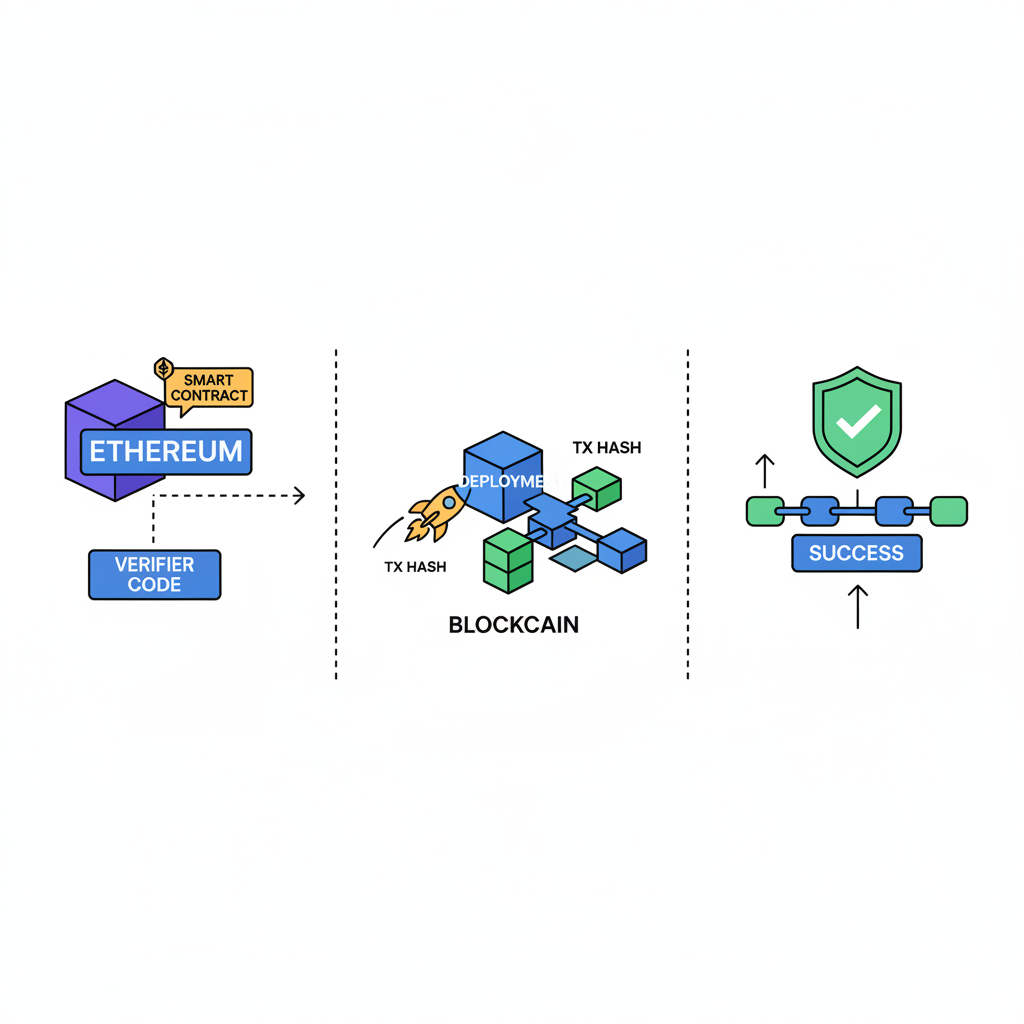
ethereum smart contract verifier deployment blockchain
Deploy Verifier Smart Contract
Deploy Solidity verifier from snarkjs export to Ethereum L2 (e.g., Optimism). Contract verifies proof against public salary commitment. Add payroll function: require(verifyProof(proof, publicSignals)); emit PayrollVerified(commitment);. Use OpenZeppelin for access control (DAO multisig).
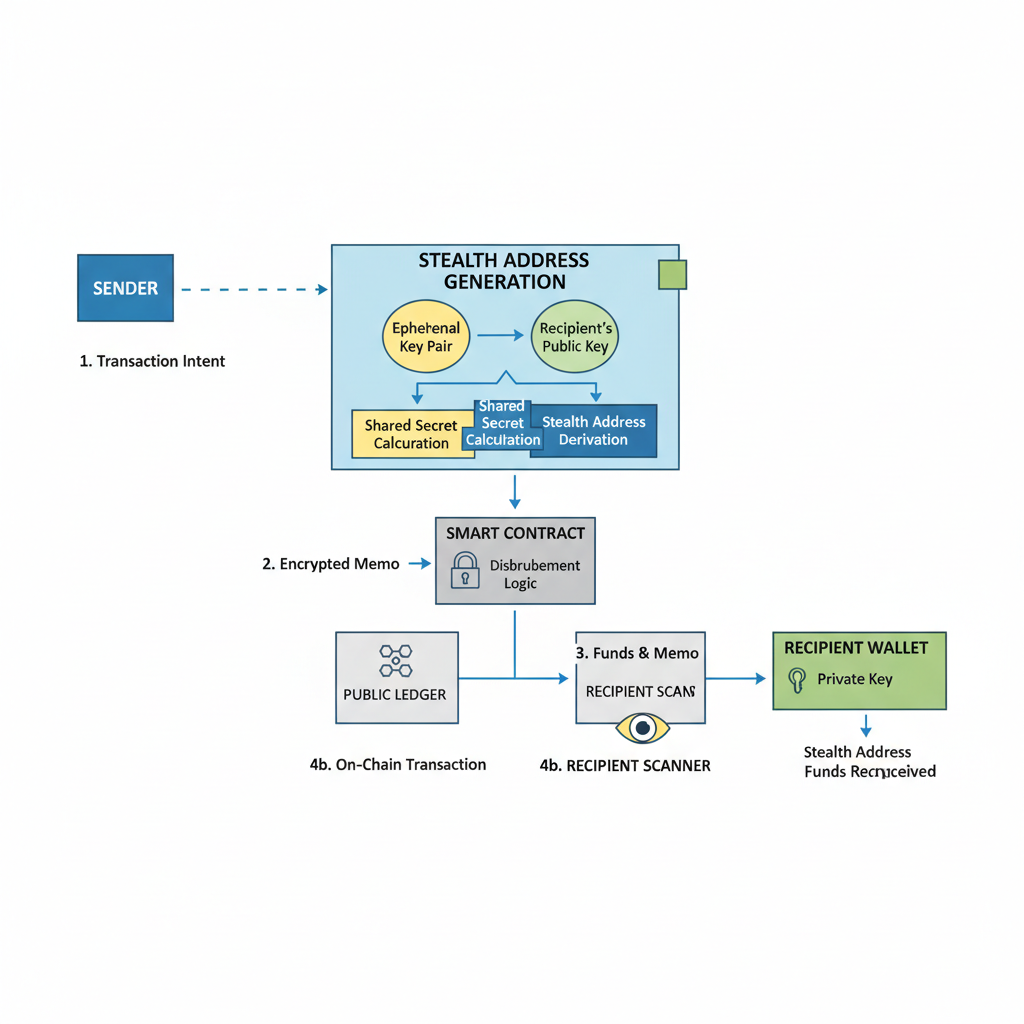
stealth address generation disbursement diagram web3
Integrate Stealth Address Disbursements
Generate stealth addresses for recipients: ephemeral key + viewing key derive spending address. DAO treasury sends to stealth address post-verification. Use Semaphore or Tornado Cash primitives for mixer-like privacy. On verification: transfer USDC to stealth address from treasury.
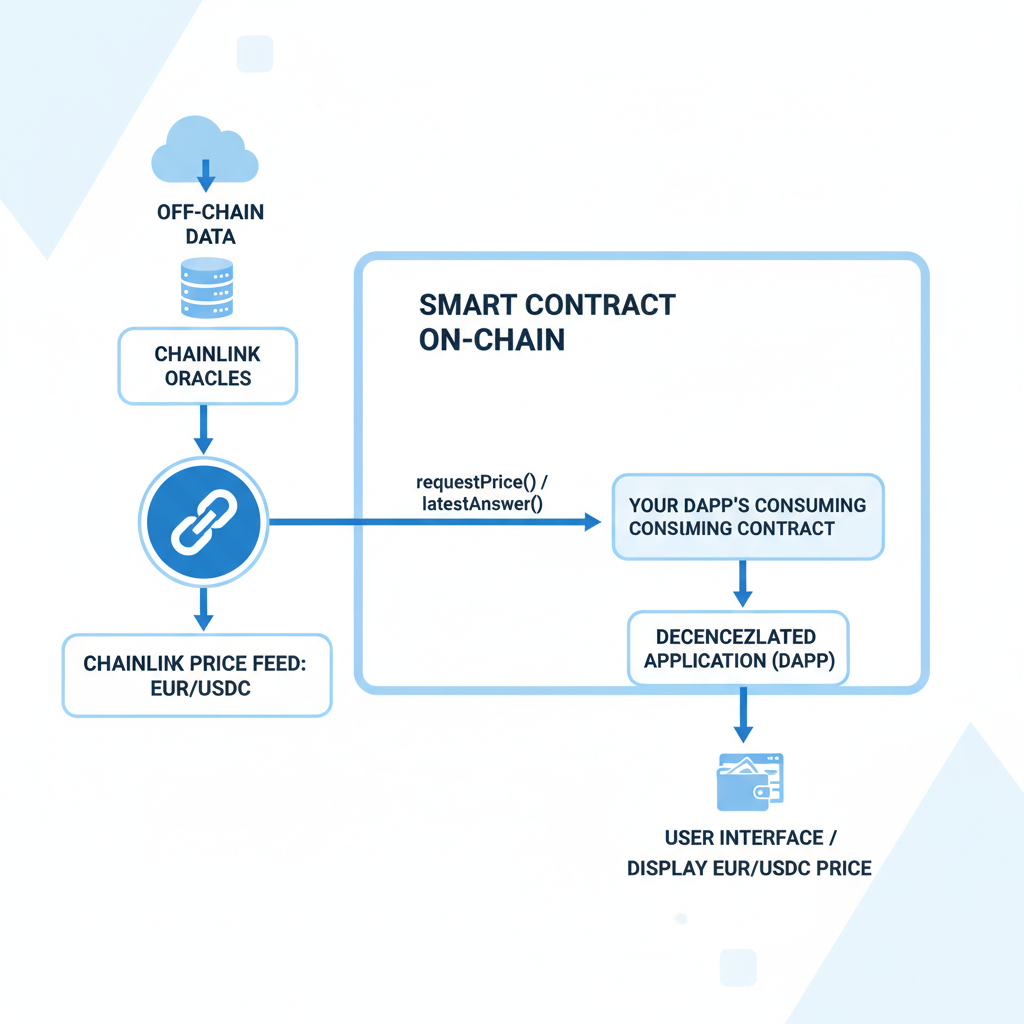
chainlink oracle price feed eur usdc integration diagram
Setup Chainlink Oracle for EUR/USDC
Integrate Chainlink Data Feeds for EUR/USD and USDC/USD rates. In circuit/public signals, include oracle price for conversion: salaryEUR * oracleRate = salaryUSDC. Verify onchain: require(salaryUSDC == publicSalary); shields VAT/volatility by proving against latest feed without exposing inputs.
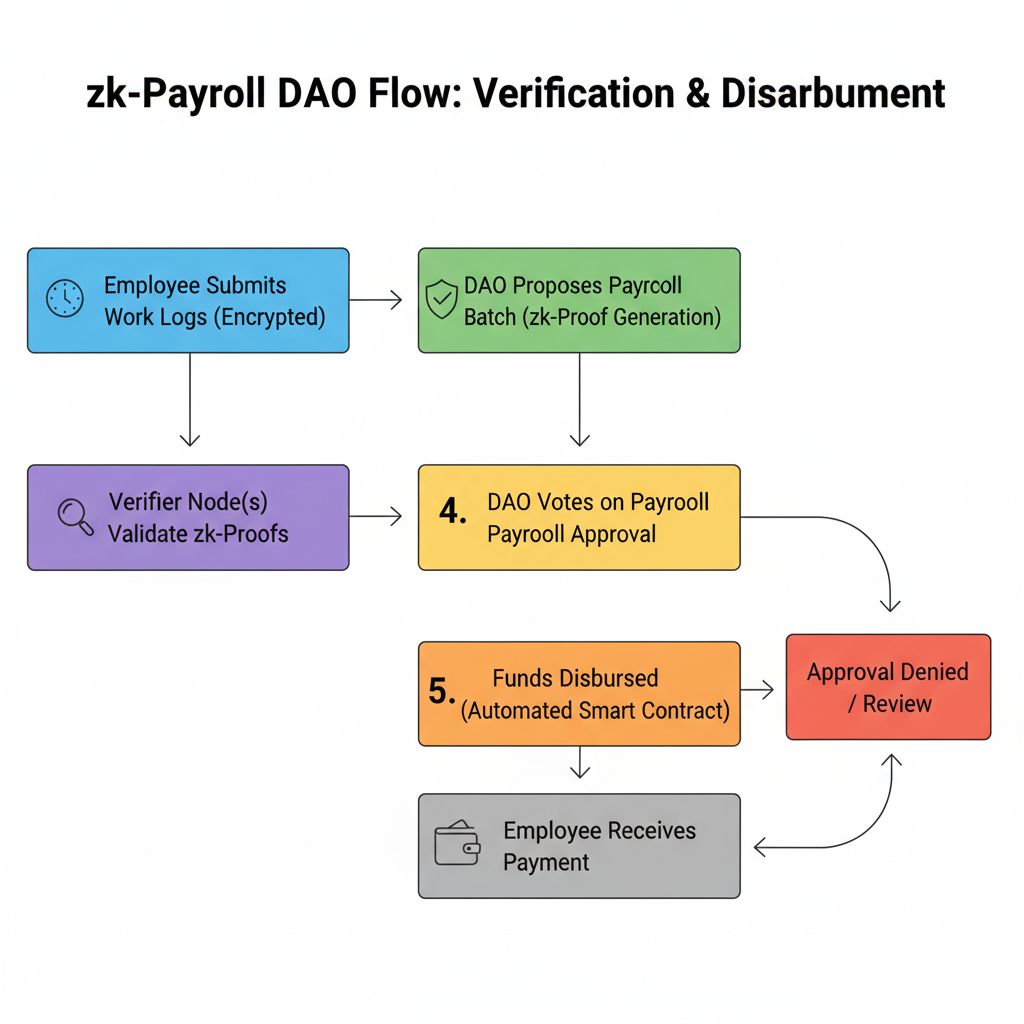
complete zk payroll dao flow diagram verification disbursement
Execute & Test Full Payroll Flow
DAO contributor submits encrypted data to relayer → proof gen → onchain verification → stealth disbursement. Test: mock hours=40, rate=50EUR/hr, VAT=20%, oracle EUR/USDC=1.08 → salary~2576 USDC. Audit with Foundry: forge test –match-path PayrollConfidential.t.sol.

NotebookLabs’ ZK identity layer complements this by verifying contributor credentials anonymously, raised $3.3M to scale such infrastructure. Aragon’s insights on ZKPs for private DAOs underscore verifiability: anyone audits proof validity without peeking at salaries, preserving governance trust.

Yet skeptics linger, echoing Hacker News doubts on tech-first problem solving. I counter that payroll privacy isn’t hype; it’s necessity. Transparent chains invite exploits, from targeted phishing to regulatory scrutiny on exposed incomes. ZKPs solve proven pain points, not invented ones.

Overcoming Hurdles: Scalability, Compliance, and Adoption

Scalability hinges on recursive proofs and aggregation; STARKware’s advancements pack thousands of payroll proofs into single transactions. Compliance weaves in via oracle-attested rules: prove 30% US tax withholding for American contributors without naming them. Global DAOs benefit immensely, converting BRL to stablecoins privately amid Brazil’s forex swings.

Aleo’s partnerships with Toku and Paxos Labs pioneer compliant crypto payroll, blending ZK with fiat onramps. Nillion’s SMPC nodes handle blind multi-party approvals, ideal for treasury signers verifying spends collectively sans collusion risks. TEEs add hardware enclaves for hybrid setups, processing AI-driven contribution scoring securely.

Adoption accelerates as tools mature. zkMe’s credential system lets DAOs verify KYC or skills proofs, essential for secure contributor payments in regulated jurisdictions. Costs drop yearly; today’s 100k gas proofs hit sub-10k on optimized L2s.

ZKPs Demystified: Privacy & Payroll for DAOs

What are Zero-Knowledge Proofs (ZKPs)?
Zero-Knowledge Proofs (ZKPs) are cryptographic protocols that enable one party (the prover) to convince another (the verifier) that a given statement is true without revealing any additional information beyond the statement’s validity. In Web3 payroll, ZKPs allow DAOs to verify transaction details like payout amounts and contributor eligibility on public blockchains such as Starknet without exposing sensitive data like individual salaries or identities. Protocols like @meet_civitas leverage Nillion’s nilCC and nilDB privacy stack to perform these computations securely using Secure Multi-Party Computation (SMPC), ensuring total financial privacy for decentralized teams.
🔐
How do ZKPs ensure privacy in DAO payroll systems?
ZKPs ensure privacy by allowing selective disclosure—proving facts like ‘contributor X is eligible for Y payout’ without revealing exact salaries, personal details, or full transaction histories. For instance, @meet_civitas on Starknet uses Nillion’s privacy infrastructure to process encrypted payroll data onchain, preventing exposure on transparent ledgers. This addresses blockchain’s inherent publicity issue, combined with techniques like Trusted Execution Environments (TEEs), enabling DAOs to maintain confidentiality while operating transparently for verifiability.
🛡️
What are the integration costs for ZKPs in DAO payroll?
Integration costs for ZKPs vary but are increasingly accessible on Layer 2 networks like Starknet, where gas fees remain low (often under $0.01 per proof). Initial development involves creating ZK circuits for payroll logic, costing $10K–$50K for custom setups via tools from Nillion or zkMe. Ongoing costs include node operations for SMPC networks, but protocols like @meet_civitas minimize this through optimized nilDB storage. Compared to traditional offchain solutions, ZKPs offer long-term savings via automation and compliance reductions.
💰
What compliance benefits do ZKPs provide for DAOs?
ZKPs enable DAOs to prove regulatory compliance—such as tax withholdings, KYC verification, or payout thresholds—without disclosing underlying data, satisfying auditors via zero-knowledge credentials. Solutions like zkMe facilitate secure issuance and verification of credentials, while integrations with TEEs ensure tamper-proof processing. This aligns with global regs like GDPR or FATCA, reducing legal risks for Web3 teams and allowing seamless cross-border payroll without public exposure of sensitive financials.
⚖️
How scalable are ZKP-based payroll solutions for DAOs?
ZKP payroll is highly scalable due to advancements in recursive proofs and L2 scaling on Starknet, handling thousands of transactions per second. Nillion’s decentralized node network using SMPC supports massive datasets without blockchain bloat, while projects like @meet_civitas demonstrate production-ready infrastructure for Web3 teams. Future upgrades in hardware-accelerated provers (e.g., Galot’s ZK cloud) will further reduce proof generation times to milliseconds, making it viable for global DAOs with growing contributor bases.
🚀

Projects like Civitas set the benchmark, but expect fragmentation: Starknet for scale, Ethereum L2s for liquidity, Solana for speed via Light Protocol hybrids. My view? Borderless teams win big. Forex-exposed payrolls, once audit nightmares, become automated, private rails. DAOs forecast rates technically, settle blindly, and comply effortlessly, scaling to thousands without doxxing a soul.

This evolution redefines web3 work. Contributors focus on impact, not exposure; treasuries enforce rules verifiably. As ZK stacks proliferate, ZK proofs DAO payments transition from novel to standard, fortifying the decentralized economy against privacy’s erosion.


Leave a Reply

Your email address will not be published. Required fields are marked *