Why standard payroll tools fail DAOs
Traditional payroll infrastructure was built for centralized enterprises with fixed legal entities and single-currency operations. When applied to decentralized autonomous organizations (DAOs), these legacy systems create immediate friction. The core issue is not just administrative overhead, but structural incompatibility between off-chain banking rails and on-chain treasury management.
The most visible failure point is foreign exchange (FX) and cross-border latency. A DAO contributor in Nairobi paid in USD via a standard bank transfer faces days of settlement time and significant spread fees. By contrast, DAO payroll rails like stablecoin distributions allow for near-instant settlement across borders. A provider such as Rise Works illustrates this shift: the system funds payroll once in USDC and handles distribution across 90+ local currencies and 100+ crypto assets, eliminating the need for multiple intermediary banks and reducing settlement time from days to seconds.
Beyond speed, classification risk creates legal exposure. Traditional payroll requires strict employee vs. contractor distinctions that are difficult to enforce in anonymous or pseudonymous DAO environments. Misclassification can lead to back taxes and penalties. On-chain payroll introduces smart contracts that automate compliance checks and tax withholding at the source, reducing the liability burden on the treasury.
The financial impact is measurable. Consider the volatility of native assets or the spread costs of fiat conversions. For a DAO with global contributors, the cumulative cost of traditional banking fees and FX spreads can erode treasury value significantly over time. This is why many DAOs are migrating to on-chain payroll solutions that align with their decentralized nature.
How stablecoin payroll rails actually work
DAO payroll rails replace traditional banking infrastructure with a streamlined on-chain workflow. The process begins with the DAO treasury funding a multisig wallet with stablecoins, typically USDC. This single deposit serves as the liquidity pool for the entire payroll cycle, eliminating the need for multiple fiat transfers across different jurisdictions.
Once the funds are secured in the multisig, a payroll processor acts as the execution layer. Providers like Rise Works automate the conversion of these stablecoins into local currencies or other crypto assets. According to Rise Works, their system handles distribution across 90+ local currencies and 100+ crypto assets, allowing the DAO to pay contributors in their preferred asset without managing individual FX rates or bank accounts.
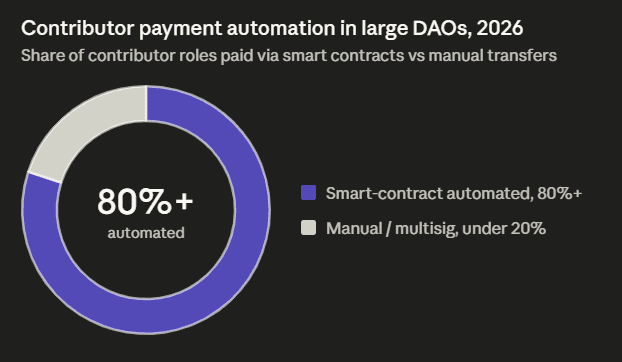
The final distribution occurs via smart contracts that execute payments automatically based on predefined schedules. This creates a transparent, immutable record of compensation that is visible on-chain. For DAOs, this reduces administrative overhead and ensures that contributors are paid reliably, regardless of their location or banking infrastructure.
To understand the underlying asset stability that makes this model viable, consider the performance of the primary funding currency.
The stability of USDC against the US dollar is critical for payroll predictability. While minor fluctuations occur, the peg remains tight, ensuring that the value of the payroll pool does not erode significantly between funding and distribution. This stability is what allows DAOs to treat stablecoin payroll as a reliable alternative to traditional fiat rails.
Stablecoin base with token upside
This structure treats compensation as a hybrid instrument: a stablecoin salary covers immediate living expenses, while a separate token allocation aligns long-term incentives. It is the "adult in the room" model, separating operational survival from speculative upside. The stablecoin leg—typically USDC or DAI—provides predictable purchasing power, insulating contributors from the volatility that plagues pure-token compensation. This stability is critical for retaining talent in a high-turnover industry.
The token leg functions as a performance multiplier. Allocated via vesting schedules, it ties the contributor’s wealth to the DAO’s treasury health. If the protocol succeeds, the token upside compounds; if it fails, the stablecoin base remains intact. This dual-layer approach mitigates the risk of total income collapse during bear markets, a common failure point for early-stage DAOs.
For DAO payroll rails, this model requires robust treasury management. The stablecoin leg must be funded by reliable revenue streams or grants, while the token leg requires clear minting or distribution mechanics. Without transparent accounting, the promise of "upside" becomes hollow. Contributors need to see the stablecoin arriving reliably to trust the token promises later.
Retainer plus bounties for sprint work
This hybrid model structures DAO payroll rails by combining a steady base retainer with performance-based bounties. The retainer secures contributor availability and covers foundational operational costs, while smart-contract-triggered bounties compensate for specific, measurable deliverables. This approach balances financial stability with high-stakes incentive alignment, ensuring that contributors remain engaged even when market volatility disrupts broader DAO treasury flows.
The base retainer acts as a liquidity anchor, providing predictable income for core team members or long-term contractors. In contrast, the bounty layer introduces a variable cost structure tied directly to output. Smart contracts automate the release of funds upon verification of completed tasks, reducing administrative overhead and mitigating the risk of misaligned incentives. This mechanism is particularly effective for sprint-based work, where clear milestones can be defined and verified on-chain.
From a risk management perspective, this model requires precise definition of bounty criteria to avoid disputes. DAOs must establish transparent verification processes, often involving multi-signature wallets or decentralized oracle networks, to confirm that work meets the required standard before funds are released. While this adds complexity to the initial setup, it significantly reduces the long-term friction associated with manual payroll processing and subjective performance reviews.
| Component | Function | Risk Profile |
|---|---|---|
| Base Retainer | Secures availability; covers fixed costs | Low; predictable cash outflow |
| Smart-Contract Bounties | Pays for verified deliverables | Medium; requires clear scope definition |
The integration of these payroll rails often correlates with the health of the DAO’s primary treasury asset. Monitoring the underlying token’s performance helps treasuries adjust retainer levels and bounty pools in real-time. For instance, if the treasury token experiences significant downward pressure, the DAO may need to increase the proportion of stablecoin bounties to maintain contributor morale and retention.
Peer allocation and reputation rewards
Peer allocation shifts compensation authority from a central treasury manager to the contributors themselves. In this DAO payroll rail model, peers vote on each other’s payouts based on verified work output and reputation scores. The mechanism relies on on-chain governance tokens to execute these decisions, creating a transparent ledger of who paid whom and why.
This approach reduces the risk of unilateral mismanagement but introduces its own volatility. When voting power correlates with token holdings, larger stakeholders can disproportionately influence payroll outcomes. This dynamic can stifle smaller contributors or create echo chambers where popular opinions override technical merit.
Reputation rewards layer on top of direct payments. Instead of fixed salaries, contributors earn points or non-transferable tokens that reflect their historical impact. These reputation scores often gate access to future funding rounds or higher-tier roles within the DAO. The system incentivizes long-term alignment over short-term gains.
However, subjective peer reviews can lead to groupthink or collusion. Without clear, quantifiable metrics for "good work," votes may reflect social capital rather than actual contribution. Successful implementations often combine peer votes with automated on-chain activity logs to ground reputation in verifiable data.
The efficiency of this model depends heavily on the clarity of the voting framework. DAOs that use quadratic voting or reputation-weighted ballots tend to see more equitable outcomes than those relying on simple majority rule. The goal is to balance community sentiment with objective performance indicators.
Retroactive rewards for proven impact
Retroactive compensation shifts the risk from the contributor to the protocol, rewarding DAO payroll rails only after value is realized. This model addresses the fundamental problem of measuring impact in decentralized organizations, where output is often qualitative and long-term. By deferring payment until a contribution has demonstrably improved the network, DAOs align incentives with actual utility rather than mere activity.
Implementing this model requires rigorous on-chain verification. Merkle tree distributions allow for efficient, gas-optimized payouts to verified contributors without exposing individual identities prematurely. Vesting schedules then ensure that rewards remain locked until the projected impact materializes, preventing immediate sell-offs that could destabilize the token economy. This approach mirrors venture capital structures, where liquidity is restricted until the company reaches specific milestones.
The primary challenge lies in defining "proven impact" objectively. DAOs must establish clear, measurable KPIs—such as active user growth, protocol revenue, or governance participation—before retroactive claims can be processed. Without transparent criteria, this model risks becoming a subjective exercise that erodes trust. When executed correctly, however, it creates a high-signal compensation layer that attracts builders focused on sustainable growth rather than short-term extraction.
Compliance and Contributor Classification
Automating DAO payroll rails requires more than just executing transactions; it demands rigorous adherence to labor laws. The primary risk lies in contributor classification. Misclassifying an employee as an independent contractor can trigger severe legal penalties, back taxes, and loss of equity vesting rights. Smart contracts can automate payment schedules, but they cannot automatically determine legal status across different jurisdictions.
To mitigate this, DAOs must embed classification logic into their governance frameworks. This often involves using on-chain identity verification to establish a contributor's location and tax residency before funds are released. By treating compliance as a prerequisite for smart contract execution, organizations reduce the risk of retroactive audits. The goal is to ensure that the DAO payroll rails support both operational efficiency and legal defensibility.
Treasury management systems are evolving to handle these complexities. Platforms like Rise and TransFi are integrating stablecoin payroll with cross-border payment infrastructure, allowing DAOs to distribute funds in local currencies while maintaining a unified treasury. This approach simplifies the administrative burden, ensuring that contributors are paid correctly and compliantly, regardless of where they reside.
Checklist for launching automated payroll
Implementing DAO payroll rails requires precision. A single configuration error can trigger tax liabilities or lock treasury funds. Use this five-step sequence to deploy compensation models safely.
Map compensation to roles. Decide between fixed salaries, milestone-based payouts, or hybrid models. Document each structure to ensure smart contracts execute the correct logic.
Choose a payroll rail that supports your required currencies and jurisdictions. Verify compliance features, such as automated tax withholding and multi-currency conversion capabilities.
Link the payroll smart contract to a multisignature wallet. Require multiple signers to approve each payroll batch. This prevents single points of failure and ensures transparency.
Run a dry run with one or two contributors. Verify that gas fees are covered, addresses are correct, and tax documents generate properly. Fix any errors before full deployment.

Activate the rail for the entire organization. Monitor the first two cycles closely. Adjust parameters as needed to optimize for gas efficiency and contributor satisfaction.
No comments yet. Be the first to share your thoughts!